- Feb 25, 2025
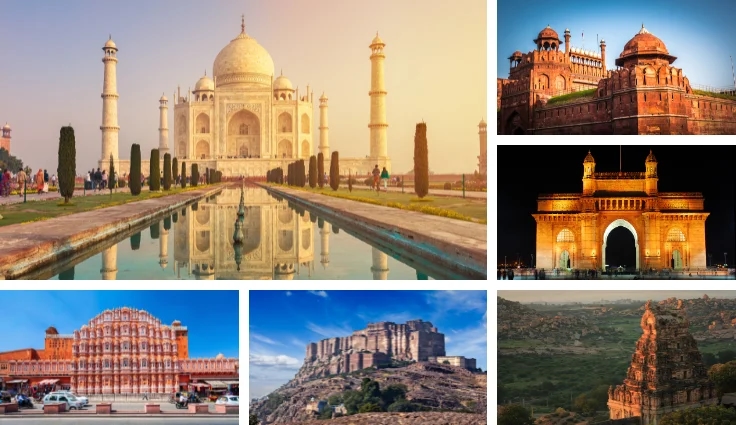
India is a treasure trove of historical and cultural landmarks that showcase a captivating blend of diverse traditions, including Hindu, Islamic, Persian, Turkish, and British influences. The country boasts an astonishing array of sites, from majestic forts and grand palaces to sacred temples and mysterious ruins of ancient metropolises. Each location tells a unique story, steeped in rich history and architectural brilliance, inviting travellers to immerse themselves in its splendour. In this blog, you will explore some of the finest historical places in India, with detailed descriptions highlighting the unique characteristics and significance of each site. Prepare to embark on a journey through time as we uncover the vibrant tapestry of India’s past.
20 Famous Historical Places In India
1. Taj Mahal, Agra
The finest example of Mughal architecture and a jewel of Muslim architecture in the country, the Taj Mahal blends elements of Indian, Persian, and Islamic architectural styles and has become one of the seven wonders of the world. The mausoleum that reveals the potential of the paradisical garden, located in front of the river Yamuna, in two ways: first, as an ideal memorial and second, as a practical worldly construct, has become the most popular tourist spot in India.
- Best time to visit: The cooler months, from October to March.
- Nearby places to visit- Mehtab Bagh, Agra Chaupati, Soami Bagh, Agra Fort, Fatehpur Sikri, Akbar's Tomb, and Itimad-ul-daula's Tomb.
2. Red Fort, Delhi
An iconic and historic fort built by Shah Jahan between 1638 and 1648 stands as a symbol of the power and beauty of that time and served as the centre of administration and the main residence of the Mughal Emperor for more than 200 years. Once the heart of the Mughal empire, it now symbolises India's glorious past, where every year on the country's Independence Day, the honourable Prime Minister hosts the national flag discourse for the nation.
- Best time to Visit- Months between October and March
- Nearby Tourist Spots- Jama Masjid, Chandni Chowk, India Gate, Qutub Minar, Lodhi Garden, Raj Ghat, Akshardham Temple, and Humayun's Tomb
3. Gateway of India, Mumbai
A 20th-century arch-monument, the Gateway of India, was constructed from 1911 to 1924 to honour and celebrate the historic visit of King George V and Queen Mary to Apollo Bunder in India. This 26-meter-high Indo-Saracenic-style architecture was later used by the Viceroys and Governors of Bombay as a symbolic official entrance to India. The Arabian Sea-facing monument located in South Mumbai has been referred to as the Taj Mahal of Mumbai and has served as a popular tourist spot in the city.
- The best time to visit is between October and February.
- Nearby places to visit- Juhu Beach, Mount Mary Church, Chhatrapati Shivaji Maharaj Terminus, Film City, ISKON Temple, and the National Gallery of Modern Art.
4. Hawa Mahal, Jaipur
A spellbinding and one of the most stunning architectural landmarks in Rajasthan, Hawa Mahal was built in the heart of Jaipur by Maharaja Sawai Pratap Singh in 1799. With a beautiful blend of Islamic and Rajput architecture, it creates a stunning interior and exterior with a lovely pink facade. The palace got its name because of its marvellous and thoughtful creation of 953 windows, producing a honeycombed cooling system that helps keep the place cool and well-aired throughout the year.
- Best time to visit- Months between October and March
- The top spots to visit nearby- Albert Hall, Jaipur Wax Museum, Gaitore, Moti Dongri, Central Park, Birla Temple, and Jal Mahal
5. Mehrangarh Fort, Jodhpur
One of the best-preserved forts in India, the Mehrangarh Fort still stands as the pride of Jodhpur atop a 400-foot-tall cliff, thus reigning supreme over the city's skyline. The fort houses several palaces and museums, beautifully showcasing the glorious, luxurious past and magnificently reflecting the cultural and artistic history of Rajasthan. At present, it serves as an amazing tourist destination, offering a breathtaking view of Jaipur.
- Best time to visit- Months from October to March
- Other popular nearby attractions- Dhawa Doli Wildlife Sanctuary, Arna Jharna, Toorji ka Jhalra, Jaswant Thada, Sardar Government Museum, and Mahamandir Temple.
6. Hampi, Karnataka
The grand site of Hampi was the capital of the Vijayanagara Empire, the last great Hindu kingdom of India, during its heyday. The luxurious princes of the city constructed many temples and palaces, which helped to enrich Dravidian architecture and bring it to its climax. Though the importance of the site of Hampi dwindled gradually, it still holds a great admiration for travellers across the world as its iconic landmarks, austere temples, enchanting street market, and intriguing remains of the Vijayanagara Empire provide a gorgeous glimpse of ancient history and became a UNESCO World Heritage Site.
- Best time to visit- Months between October and February
- Top Attractions within Hampi- Vittala Temple, Virupaksha Temple, Sasivekalu Ganesha Temple, Elephant Stables, Badavilinga, Mahanavami Dibba, and Queen's Bath.
7. Victoria Memorial Hall, Kolkata
Not just one of the most magnificent monuments in India, Victoria Memorial Hall is also one of the most popular tourist spots in the country and stands as the true icon of Kolkata. The resplendent architecture of the hall was created as a memorial to the deceased Queen Victoria, representing the Renaissance of the dazzling and striking Italian style, blended with Indian influence. In addition to the memorial, the spectacular monument also serves as a premier art gallery, cultural space, museum, and research library on the history of art.
- Best time to visit- Months from October to March
- Nearby Top Attractions- Maidan, Belur Math, Howrah Bridge, Indian Museum, Dalhousie Square, and Dakshineshwar Kali Temple.
8. Gwalior Fort, Madhya Pradesh
Towering on the hilltop of Gwalior city, the Gwalior Fort is the most significant, as well as dominating structure of the city. This eighth-century fort has a long history of survival, witnessing and exploring various momentous events, fiercest battles, myriad imprisonments, and instances of sati. It houses some wonders of medieval times architecture, including the Gujari Mahal, Man Mandir Palace, Karan Mandir, Vikram Mahal, Sher Mahal, and many more.
- Best time to visit- Months between October and March
- Other popular attractions nearby- Sun temple, Gwalior Zoo, Teli ka Mandir, Saas Bahu Temple, Gujari Mahal Museum, and Tansen Memorial.
9. Mahabalipuram Shore Temple, Tamil Nadu
Drenched in bewitching old-world charm, the Mahabalipuram (Mamallapuram) Shore Temple showcases the splendid architecture of Southern India. A 13th-century granite carving and UNESCO World Heritage Site is renowned for its intricate carvings and crumbling beauty, and it exhibits the Palasavas' power to create exquisite, complex temple architecture. It also showcases its unique feature of housing three separate shrines dedicated to both the preserver of the world, i.e., Lord Vishnu, and the destroyer of the world, i.e., Lord Shiva.
- Best Time to visit- Months from November to February
- Nearby top attractions- Mahabalipuram Beach, Sculpture Museum, Arjuna's Penance, Krishna's Butterball, Mahabalipuram Seashell Museum, and Cave temples.
10. Sanchi, Madhya Pradesh
The oldest Buddhist sanctuary and a major 12th-century hub for Buddhists in the country, Sanchi comprises a unique and remarkable testament to Buddhist art and architecture, including stupas, viharas, temples, monolithic pillars, and stambha. Gradually, the stupas and the place lost their sanctity and were forgotten, but they were rediscovered and restored in 1881 and once again became the most reminiscent and attractive site in India.
- Best time to visit- Either in the month of July or from October to March
- Nearby popular attractions- Van Vihar National Park, Bhimbetka Rock Shelter, Shaurya Smarak, Udayagiri Caves, Moti Masjid, and Lakshmi Narayan Temple.
11. Konark Sun Temple, Odisha
An outstanding 13th-century architectural marvel and a magnificent testament to devotion and creativity, the Konark Sun Temple of Odisha showcases the zenith of Odisha Temple Architecture. A massive temple and prominent tourist attraction is dedicated to the Sun God, Surya, where the Sun God's chariot is beautifully carved, with 24 wheels that accurately track time as the sun passes across the sky and the shadow falls over the Daedalian spokes of the chariot.
- Best time to visit- Between October and February.
- Nearby popular attractions- Chaurasi, Balukkhand Konark Sanctuary, Sri Jagannath Temple, Atharnala Bridge, Puri Beach, and Satpada Dolphin Sanctuary.
12. Mysuru Palace, Mysore
Built in the 14th century, the Mysore Palace is an incredible, scenic example of the Indo-Saracenic Style and has served as the official residence of the Wodeyar Dynasty. Once the seat of Mysuru, the palace was destroyed three times by natural and anthropogenic causes; thus, it is the fourth reconstruction of the original wooden architecture built in 1912. It houses many remarkable temples in the city, along with some renowned points, including the Doll's Pavilion, Golden Throne, Darbar Hall, Marriage Pavilion, wrestling courtyard, Portrait Gallery, and Painting Gallery.
- Best time to visit- Around the festival of Dussehra.
- Nearby top attractions- Ranganathittu Bird Sanctuary, Devaraja Market, Mysuru Railway Museum, Brindavana Gardens, Nagarahole Tiger Reserve, and Melukot.
13. Khajuraho Temples, Madhya Pradesh
Renowned for its rich Nagara-style architecture and magnificent, intricate sculptures of nayikas and deities, the Khajuraho Temple Complex, built during the Chandala Dynasty, displays the splendour of Hindu and Jain temple architecture. With the fall of the Chandala Dynasty, the complex was destroyed by invaders, leading to its complete isolation. It was only in the 1830s that Britishers found the site and started to establish the temples' previous glory.
- Best time to visit- Months between October and February.
- Nearby attractions- Adivrart Tribal and Folk Art Museum, Panna National Park, Raneh Fall, Maharaja Chhatrasal Museum, Pandav Fall, and Jain Museum.
14. Charminar, Hyderabad
A 48.7-meter-tall iconic symbol and landmark of Hyderabad, Charminar is an elegant example of the beautiful blend of Hindu and Islamic architectural styles. This magnificent architecture was created in 1591 by Sultan Mohammed Quli Qutb Shah. It has a mosque and prayer spaces that allow visitors to reflect on their spirituality and calm their minds, as well as personify Hyderabad with its great historical, cultural, social, and economic values.
- Best time to visit- Months from October to February
- Attractions Nearby- Nehru Zoological Park, Birla Temple, Nagarjuna Sagar Dam, Golconda Fort, KBR National Park, Spanish Mosque, and St. Mary's Church.
15. Amber Fort, Jaipur
With a spectacular blend of Rajput and Mughal architecture, Amber Fort exhibits a glorious era and rich history and culture of the Rajputs. The fort, which was commissioned in 1952 by Raja Man Singh I, has witnessed the fiercest battles, grand celebrations, and royal ceremonies of various dynasties. The fort even offers elephant rides for visitors to experience real royal splendour and explore the breathtaking surroundings and landscape.
- Best time to visit- Months from October to February
- Nearby attractions- Sambhar Lake, Sunehari Kothi, Jaigarh Fort, Jal Mahal, Kanak Vrindavan, Nahargarh Biological Park, and Garh Ganesh Temple.
16. Ellora Caves, Maharashtra
One of the world's largest rock-cut monastic-temple complexes, the Ellora Caves houses the three prominent religions of India, including Hinduism, Buddhism, and Jainism, thus illustrating the country's tolerant spirit, harmony, and synchronicity. The caves contain many Hindu temples, Buddhist chaityas and viharas, and Jain shrines. The Kailasha Temple is the most famous temple in the entire complex of around 100 caves, as it is the world's largest monolithic excavation.
- Best time to visit- Either the monsoon season from August to September or the winter season from November to February.
- Nearby attractions- Grishneshwar Jyotirlinga Temple, Bhadra Maruti, Mughal Silk Bazaar, Daultabad Fort, Chand Minar, and Hemadpanthi Temple Mosque.
17. Golden Temple, Amritsar
One of the most sacred holy sites for Sikhs and a cultural icon of Punjab, the Golden Temple captivates devotees and tourists worldwide, regardless of religion. The temple, also known as Sri Harminder Sahib, beautifully blends Hindu and Islamic architectural styles and is renowned for its golden dome, spiritual aura, and intricate architecture. A sacred pool, Amrit Sarovar, surrounds the Golden Temple, thus helping to offer a tranquil and calm environment to its visitors.
- Best time to visit- Months between October and March
- Nearby attractions- Jallianwala Bagh, the Partition Museum, Sri Akal Takht Sahib, Shri Durgiana Temple, Tarn Taran Sahib, and Ram Tirth Temple.
18. Humayun's Tomb, Delhi
The first-ever Garden Tomb in the entire Indian Subcontinent, Humayun's Tomb, represents a mesmerising monument and a charnel house of the late Mughal Emperor Humayun. Humanyu's senior wife, Bega Begum, commissioned the mausoleum, demonstrating the love between a husband and wife. This architectural marvel showcases the use of red sandstone in Delhi for the first time in such a large monument, paving the way for its use in almost every architectural work during the Mughal Period, which has become synonymous with Mughal grandeur.
- Best time to visit: October to March.
- Nearby attractions- Nizamuddin Dargah, Purana Qila, Sunder Nursery, Lodhi Garden, National Zoological Park, Crafts Museum, and Waste to Wonder Park.
19. Talatal Ghar, Assam
Built-in 1765 CE, Talatal Ghar is the largest monument in Tai-Ahom’s construction history. It was initially a seven-storey palace, the first three storeys of which are known as Talant Ghar and are buried underground. In contrast, the upper storeys are known as Kareng Ghar. Originally an army base, the palace became the Ahom Kingdom’s seat of the Royal Court and Administrative Office, along with its Strategic Military Headquarters. The above-ground two-storey monument still stands and is open to visitors, who can explore intricate galleries and several pavilions on its large flat rooftops.
- Best time to visit: Particularly in October and November.
- Nearby attractions- Gola Ghar, Rang Ghar, Uttaran Museum, Jaysagar Tank and Temples, Kareng Ghar and Talat Ghar, Pani Dihing Wildlife Sanctuary, and Tai Ahom Museum.
20. Mawsmai Cave, Meghalaya
One of the longest cave systems in the country, Mawsmai Cave, is 150 meters long and located in the Jaintia Hills of Cherrapunji in Meghalaya. The natural limestone cave in Meghalaya is striking and a true paradise for history enthusiasts and thrill-seekers alike. The architecture of the cave ranges from the development of stalactites and stalagmites to the joining of the roof and floor to form a column, and from the large openings to the tiny ones one must crawl through.
- Best time to visit: post-monsoon season.
- Nearby attractions- Mawsmai Falls, Dawki, Mawkdok Dympep Valley, Thangkharang Park, and Mawphlang Sacred Forest.
FAQs
Q. Which are famous historical places in South India?
South India houses some significant historical places, including Hindu Pilgrimage sites like Tirupati, Rameshwaram, Velankanni, and Udupi and heritage sites such as Hampi, Mysore, Mahabalipuram, and Thanjavur.
Q. Which are famous historical places in North India?
North India is home to a myriad of historical and cultural sites, such as the Taj Mahal, Red Fort, Humayun's Tomb, Ajanta Caves, Fatehpur Sikri, Hawa Mahal, Victoria Memorial, and many more.
Q. Which are the historical places in Rajasthan, India?
Ans. According to the Archaeological Survey of India, Rajasthan has around 163 monuments of historical importance. Some popular monuments include the Hawa Mahal, Jal Mahal, Jantar Mantar, Mehergarh Fort, and Jaisalmer Fort.
Q. What is India's most significant heritage?
Ans. Some of India's top UNESCO World Heritage sites include the Mahabodhi Temple in Bihar, the Taj Mahal in Agra, Hampi in Karnataka, Khajuraho in Madhya Pradesh, and the Ellora and Ajanta Caves in Maharashtra.
Q. Which is the Indian No. 1 tourist place?
Ans. The Taj Mahal in Agra is one of the world's seven wonders and is thus India's most famous and number-one tourist destination.
Q. What is the oldest historical place in India?
Ans. According to the Archaeological Survey of India, Bhirrana, located in the Fatehabad District of Haryana and an Indus Valley Civilisation site, is recognised as the oldest historical place in India.
Q. Which Indian state has the most historical places?
Ans. Uttar Pradesh, a northern state of India, maintains the most historical and cultural heritage sites, with around 3,685 monuments, and is thus recognised as the "Heartland of India."
Q. Are there any haunted historical places in India?
Ans. Yes, India is home to many haunted historical places, such as Bhangarh Fort in Rajasthan, Aashirwad (the former residence of the late actor Rajesh Khanna) in Mumbai, Golconda Fort in Hyderabad, Shaniwar Wada in Maharashtra, and the Dow Hills in West Bengal.
Q. Which historical places in India are Best for photography?
Ans. Valley of Flowers, Khajuraho, Taj Mahal, Hawa Mahal, Hampi, and Mandu are some of India's most beautiful historical places and offer the best photography locations.
Q. Do I need to buy tickets to visit historical monuments in India?
Ans. Yes, you must buy tickets to visit historical monuments, such as the Taj Mahal, Hawa Mahal, Khas Mahal, Agra Fort, and Charminar. However, some historic sites are free to visit, including the India Gate, the Lotus Temple, the Mehrauli Archaeological Park, and many more.