- Feb 23, 2026
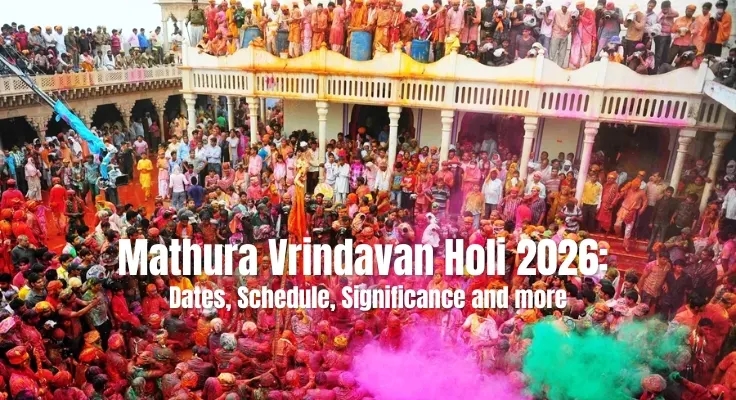
Holi means "The Festival of Colours", the only definition that you might have ever heard, isn't it? But for the Mathuravasi (the people of Mathura), it's not just about colour; it's about religious sentiment and love for the Gods Shri Krishna and Radha. The Holi celebration in Mathura-Vrindavan is unlike the rest of the world because it is not limited to colours alone and is not just a single-day celebration. Holi in Braj is celebrated for more than a week in various parts of Vrindavan with different traditional rituals, including Lathmar Holi, Phoolon-wali Holi, Laddumaar Holi, Chhadi Maar Holi, etc. Holi celebrations in Vrindavan are not just about the festival; they're a divine, unique kind of feeling you can't experience anywhere else in the world. If your excitement is pushing you to play Holi in Mathura 2026, then you must attend this festival without a second thought. In this blog, you will find important information about Braj Holi 2026, including dates, times, and related details to help you enjoy this divine festival without any hassle and with plenty of fun.
What is the Mythological Background behind Holi?
Holi is celebrated across India, as it is a big part of the nation's mythology. Holi is celebrated on the full moon day of the Phalguna month, and people are taken over by the spirit of the festival, putting aside their differences and celebrating it with pomp and show. But what does the mythology say about Holi, and why is it crucial to the Hindu religion? Let's find out.
Holika Dahan-Prahlad Mythology
The mythology behind Holi goes back to the foundation of the motto, good over evil. The story involves a king, Hiranyakashipu, who prayed long enough to be granted the five magical wishes from Lord Brahma himself. He was a devoted follower and prayed to Brahma for protection and immortality. With these five wishes, he thought he was inevitable and even thought he had more power than God himself. He ordered everyone to worship him instead of God, to which his son, Prahlad, denied and continued to worship Vishnu. Hiranyakashipu got angry and furious at Prahlad and made a plan to kill him. He asked his sister, Holika, for help, who was immune to fire. Holika and Prahlad sat on the pyre, and to everyone's surprise, Holika was burned to ashes, and Prahlad was not even scratched. Later, Hiranyakashipu was also killed by Lord Vishnu.
The Story of Radha Krishna
The love between Radha and Krishna knew no bounds, and their story is still remembered by those who have ever heard of it. The only thing that bugged Krishna was his colour: he was dark-skinned, while Radha was fair. His mother, upon hearing his concern, asked him to colour Radha in his own colour, in whichever shade and hue he liked. So, while professing his love for her, Krishna coloured Radha dark blue. Since that day, Holi has also been celebrated for the undying love between Krishna and Radha and how they playfully overcome all the obstacles.
Chasing Away Dhundhi
Once, in the kingdom of Prithu (Raghu), there was an ogress named Dhundhi, whom Lord Shiva had granted the boon that she would be immortal in the face of death by men, women, and even God himself. She kept hounding the villagers and killed them. Her terror was all around until a priest thought of a loophole and asked the children of the villagers to take her away from the village. The children went to the forest to collect wood and stones, and circled her with lit logs, playing drums, clapping, and hurling insults. Dhundhi ran away and never came back. This marks the win of unity in the face of evil.
Kamadeva's Sacrifice
Kamdeva is the God of love and passion, and he sacrificed his life to bring calm and normalcy to the world. After Sati's death, Lord Shiva sank into depression and stopped paying heed to the world and its wrongs. To make him come out of the depression, Sati was reborn as Goddess Parvati, but that did not change his love for his wife. Parvati asked Kamadeva to intervene and take the matter into his own hands. Lord Kamadeva knew the consequences, but to save the world, he pierced Shiva's heart with an arrow. This arrow made Shiva open his third eye of destruction, which incinerated Kamadeva but raised his love for Parvati. So, in South India, Dehan also refers to the pious pyre of Kamadeva, who sacrificed his life for the world.
Death of Pootna
After the birth of Lord Krishna, his uncle tried many ways to kill him to save his own life. Kansa, Krishna's uncle and the ruler of the kingdom, asked for help from the ogress, Pootna. She came into the village, abducted Krishna from her home, and fed her the poisonous milk, but in return, Krishna killed her in the process. In mythology, Pootna also represents the winter season that follows Holi. So, the Holi celebration also marks the victory of destiny and fate.
When will Holi 2026 be celebrated in Vrindavan?
In Vrindavan, Holi is not limited to a single day but spans 40 days, beginning on Basant Panchami and peaking in the last week of Holi. Each year, the city attracts devotees from all over the world and welcomes them to celebrate the supreme festival of colours. The dates, however, cause a lot of confusion, so it is better to know them beforehand to book your accommodations and manage your schedule accordingly. Below is the Vrindavan Holi schedule for 2026. Refer to it and have the best time.
| Dates (2026) | Holi Celebration | Location | Highlights |
| February 25 | Laddoo Holi | Barsana-Ladliji Temple | After the hymns, the panditjis playfully throw laddoo and sweets at the procession. |
| February 26 | Lathmar Holi | Barsana | Women gather around the lath to playfully beat the men, symbolising the love between Radha and Krishna. |
| February 27 | Nandgaon Holi | Nandgaon | The Lathmar tradition of Barsana reaches Nandgaon, and people celebrate it with fun and love. |
| February 28 | Phoolon wali Holi | Vrindavan | Instead of just playing with colours, flower petals are showered on one another on Rangbhari Ekadashi. |
| March 1 | Widow's Holi | Vrindavan | To promote inclusion, the widows play Holi together, breaking age-old stereotypes. |
| March 2-3 | Banke Bihari Temple Holi | Vrindavan | The temple dedicated to Shyam and Shayama celebrates Holi and the couple's love before the world with colours and water. |
| March 3 | Holika Dehan | Mathura | To celebrate the triumph of good over evil, Holika Dehan is performed, underscoring Prahlad's mythological victory. |
| March 4 | Rangwali Holi | Mathura & Vrindavan | The main Holi celebration, also known as Dhulandi, is celebrated with colour, abir, and water. |
| March 5 | Dauji ka Huranga | Mathura | Men splash water on the women, and the women, in response, tear off the men's clothes. |
What are the different types of Holi celebrated in Vrindavan?
While the world celebrates Holi simply with colours and water, Vrindavan sees the different hues of the traditions, all wrapped in mythology. The Holi celebration starts almost a week early in Vrindavan and is still not wrapped up by the end. You will see the festivity take its shape and reach its peak by the main Holi date. There is a relevance to every tradition people follow, which shows that a unique culture is both diverse and unified through celebration among the masses. Holi is closely associated with Lord Krishna, his love for Radha, and his playfulness, so each Vrindavan Holi has a story behind it. Let's dive into it.
Lathmar Holi
The Lathmar tradition of Holi is celebrated in Barsana and Nandgaon, where men visit the other place and are pelted with stones and sticks by the women. The laathis are made of neem chaar, and the men carry a shield with them when visiting. The story goes back to when Krishna and his cowherd friends tried to celebrate Holi with Radha and her friends. Radha, armed with her laathi, scared the group away. Since then, it has been a competition in which men from Nandgaon visit Barsana to reach Radha's temple. The women stop them with their sticks and stones. The next day, men from Barsana visit Nandgaon with the same intention to reach Nand Bhavan.
Phoolon wali Holi
The Phoolon wali Holi is celebrated in Vrindavan some days before the actual festival, when people chant the names of Lord Krishna and Radha Raman, perform their puja, and then play Holi with rose, jasmine, and marigold petals. The pandits shower flower petals on them, and the temples feel surreal, covered in flowers and their fragrance. The story behind the Phoolon wali Holi is many, and one famously known is that Radha and her friends were playing Holi with Krishna and coloured him. Krishna got angry at this and left. To appease him, Radha and her friends found the tree in bloom, placed his idol under it, and prayed. They offered flowers and apologised, to which Krishna forgave them. Since then, the way Radha celebrated and prayed to Krishna has been adopted for Vrindavan Holi.
Laddoo maar Holi
The Laddoo Maar Holi originated from Krishna's fondness for sweets, especially Laddoos. Now, the laddoos are showered on people as Lord Krishna's prasadam. The Laddoo was primarily made by Radha Laddoo, and it is now distributed as her blessing to people. The temples reverberate with the chants of Lord Krishna, bhajans, dance, and theatre performances. When Lord Krishna visited Shri Radha and her friends to play Holi, he was surprised to see them ready with Laddoo and other sweets, and they started pelting Laddoo at him.
Chhadi maar Holi
The Chhadi Maar Holi is celebrated in the village of Gokul. It is played much like Lathmar Holi, celebrating the childhood of Lord Krishna and the gopis. According to the mythology, Lord Krishna was playing pranks on Radha and her group. Radha devised a plan and carried chhadi to deal with them. Krishna and the group ran for their lives to protect themselves, and the tradition was born. Now, the thorny stems of the Acacia are burnt together. Men have to break the sticks guarded by women, and in return, the women hit them with the sticks. The streets overflow with chanting and bhajans as the festivity takes over.
Dauji ka Huranga
The day after the main Holi festival is celebrated as Dauji ka Huranga, an aggressive form of Holi that even requires permits. Dauji means 'elder brother'; in this case, it refers to Balrama, Lord Krishna's brother. The descendants of Goswami Kalyan Deo Ji perform Huranga. Balrama decided to create mischief while the others were playing Holi, so the cowherds with him began tearing people's clothes off and using them as whips. The community celebrates the festival with great pride.
How to Reach Mathura for Holi 2026 Celebration?
To visit Mathura for Holi 2026, it is advised to take public transportation to avoid the crowds. Mathura is easily accessible by all modes of transportation, so you can choose the option that best fits your preferences. The following transportation options will help you reach Mathura for Holi 2026.
By Train: The nearest railway station to Mathura is Mathura Junction, which is well-connected to various parts of India.
By Bus: You can take buses or private taxis from different parts of India to reach Mathura.
By Air: The nearest airport to Mathura is Agra Airport, approximately 60-70 km away.
What are the dos and don'ts of Holi 2026 in Vrindavan?
To play Holi in Vrindavan the right and safe way, you should pay attention to the dos and don'ts and take the necessary measures. The festival attracts huge crowds from all over the world, and it is essential that you follow them religiously. Below are tips to celebrate a safe and happy Holi in Vrindavan in 2026. Refer to them and get prepared.
- You must expect huge crowds at the temples and generally on the streets, too.
- Follow the temple and the government guidelines to ensure safety.
- Keep your camera, phones, and other valuables away from colours and water, and use waterproof cases.
- Make sure that you are dressed appropriately and modestly.
- Consider arriving at the temples early to avoid long lines or crowds.
- Carry your water bottle in public to stay hydrated and avoid exhaustion.
- Keep in mind the social boundaries and seek permission before applying colour or splashing water.
Conclusion: While the Holi vibe takes over the entire nation and significant parts of the world, the centre of attention remains in Vrindavan and Mathura. People plan their Vrindavan Holi months to have everything ready, so to catch up with them and make this Holi memorable, you can use this blog as your guide. All the crucial information is mentioned in the blog and will help you in many ways. So, pack your bags and have a blessed Holi, full of colours and love.
Frequently Asked Questions
1. When will Holi be celebrated in Vrindavan in 2026?
Holi, in Vrindavan, will be celebrated from February 25th to March 5th in 2026.
2. What are the key temples to visit in Vrindavan for Holi 2026?
The main temples to visit in Vrindavan for Holi 2026 are Banke Bihari Temple, Shri Krishna Janmabhoomi, Radha Rani Temple, Nand Bhawan, and Dauji Temple.
3. Where is Lathmar Holi played in India?
Lathmar Holi is mainly played in Uttar Pradesh in India, in the towns of Barsana and Nandgaon.
4. What are the famous foods to eat on Holi?
You should definitely try Gujiya, Thandai, Dahi Bhalle, Namak Paare, Malpua, and fritters on Holi.
5. Is there a ticket to celebrate Holi in Vrindavan in 2026?
No, there is no ticket to the temples for celebrating Holi in 2026.
6. What happens on Holika Dahan?
Holika Dahan is celebrated as the triumph of good over evil, with Holika being burned to death.
7. Why is Vrindavan the most famous place to celebrate Holi in 2026?
Lord Krishna spent his childhood in Vrindavan and played Holi with Radha, making it the most famous place to celebrate Holi in 2026.
8. Is Lathmar Holi celebrated at night too, in Vrindavan?
No, Lathmar Holi is celebrated in the morning, and not at night in Vrindavan.
Contact us