- Mar 22, 2025
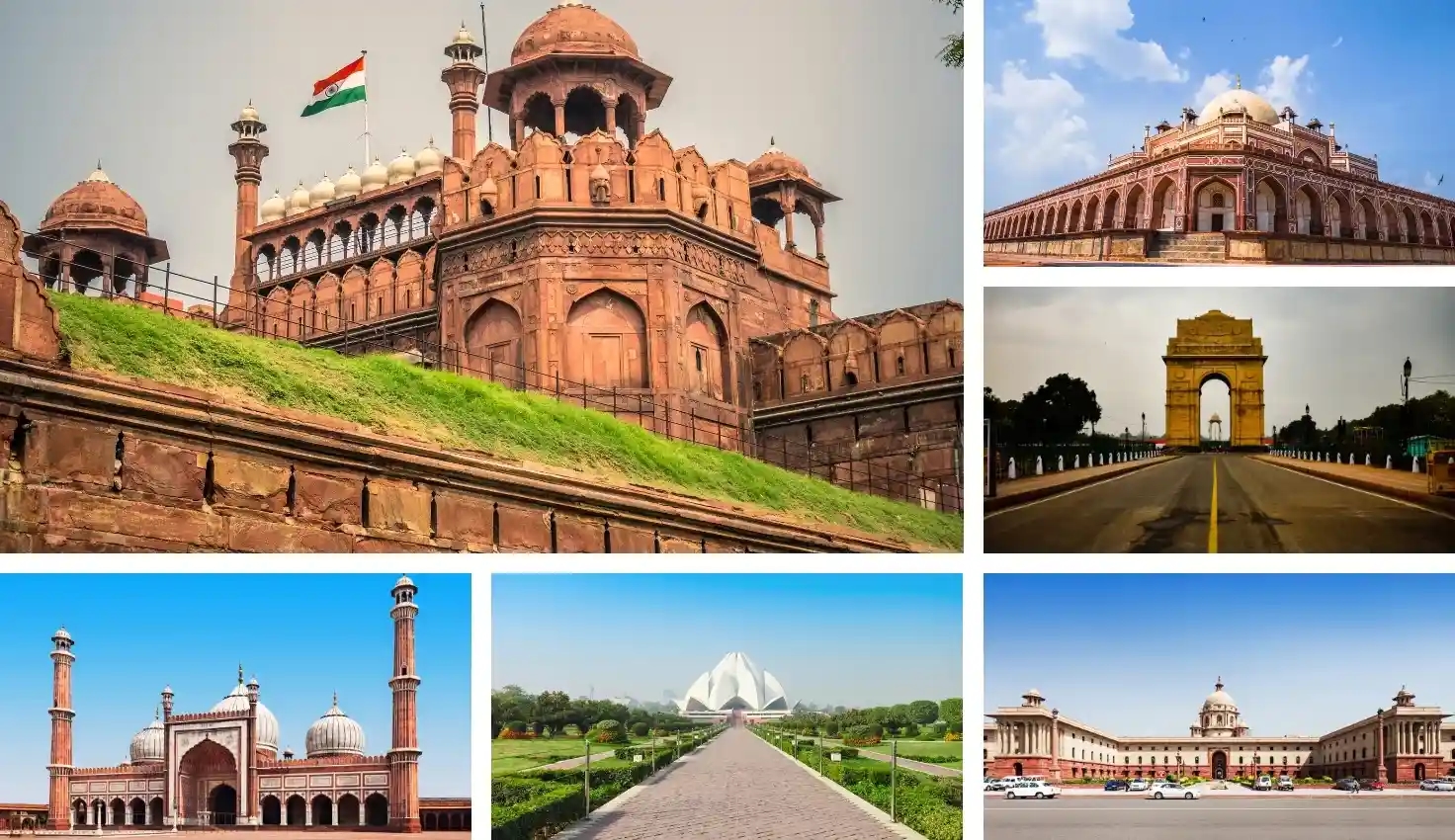
Delhi, the heart of India, is a city of great historical significance and cultural importance. The place is home to many famous structures, including monuments, forts, and tombs. The place is quite renowned for its architecture, parks, and markets. Delhi has been the capital of many empires and kingdoms, including the Mauryans, Mughals, and British. Each of the respective conquerors has left their mark on Delhi. The city is also home to the seat of all three branches of the Indian government, including the Rashtrapati Bhavan, the Sansad Bhavan, and the Supreme Court. Above all, Delhi has a rich history with many historical monuments and sites. Thus, if you plan to visit Delhi as a tourist, you must explore the following: museums, monuments, and bazaars.
1. Red Fort:
The Red Fort is considered one of the best historical places in Delhi and is also known as Lal Qila, a symbol of India's struggle for independence. Thus, it is the spot in India where the Prime Minister raises the national flag on Independence Day. The Red Fort is one of the top historical sites in Delhi, known for its vast sandstone walls. The Fort Complex includes a palace, entertainment halls, gardens, baths, and indoor canals. It is a UNESCO World Heritage Site and a major tourist attraction.
Location: Old Delhi, in the Chandni Chowk district of Delhi, India.
2. Humayun's Tomb:
Humayun's Tomb is a UNESCO World Heritage Site in Delhi, India, which was built in 1570 by Persian and Indian artisans. The feature of the Tomb is that it was built in the red sandstone and has a double-layered dome made of white marble. This building is an example of Mughal architecture, which was further influenced by Persian architecture. Thus, Humayun's Tomb was designed by Mirak Mirza Ghiyas and was a Persian centre. The Tomb has a high-terraced platform housing over 150 members of the Mughal family. Thus, visit Humayun's Tomb, witness the large garden with pools and channels, and explore the subsidiary buildings.
Location: Nizamuddin East, Delhi, near the Purana Qila (Old Fort)
3. India Gate:
India Gate is located in New Delhi and is a prominent war memorial built to honour Indian soldiers who died during World War I and the Afghan War. It was designed by the British architect Edwin Lutyens and is also a significant tourist destination for its grand architectural style, reminiscent of the Arc de Triomphe in Paris, and its historical importance as a symbol of sacrifice and remembrance of Indian soldiers. Thus, visit India Gate and explore other significant landmarks in New Delhi, such as Rashtrapati Bhavan, Parliament House, and the National Museum.
Location: Eastern end of Rajpath in the heart of New Delhi.
See also: Best Places to Visit in Delhi at Night
4. Jama Masjid:
Jama Masjid is a major tourist attraction in Delhi, India, and a place for those fond of architecture and history. This mosque was built by the Mughal emperor Shah Jahan between 1644 and 1658. Thus, there is so much more to witness and explore. While visiting Jama Masjid, you can explore the Meena Bazaar for traditional handicrafts, spices, and souvenirs. When you plan to visit, dress conservatively and remove your shoes before entering the mosque. Also, the mosque is open daily from 7 AM to 12 PM and from 1:30 to 6:30 PM.
Location: The Mosque is near the Red Fort in the heart of Old Delhi.
5. Jantar Mantar:
The Jantar Mantar is an astronomical observatory and tourist destination in India, with multiple locations in Jaipur and Delhi. The Jantar Mantar is an architectural marvel that showcases ancient Indian scientific progress. Thus, it has instruments that measure time, predict eclipses, and track the stars. Therefore, Jantar Mantar is home to some of the world's largest sundials and is also one of the most popular places for photoshoots. Thus, visit as it is open from sunrise to sunset, and you can walk around the site and observe the various instruments. Therefore, the masque's expansive courtyard can accommodate more than 25,000 people.
Location: Parliament Street, Connaught Place, New Delhi, 110001
See also: 20 Famous Historical Places In India
6. Lotus Temple:
The Lotus temple in New Delhi is a famous tourist destination and a symbol of India's cultural heritage. It is a place of worship open to people of all faiths. The temple comprises 27 marble petals in three rows of nine. Thus, the petals are further used as awnings, and the temples are surrounded by nine pools of water shaped like lotus petals. The temple's significance is that it symbolises unity and harmony and embodies the principles of the oneness of humanity. I visited the temple and witnessed its H-shaped form, which is further considered a sacred symbol by most Indians. The temple is open from 9 AM to 5 PM. Thus, the temple welcomes people of all religions and provides a quiet place for meditation and prayer.
Location: Lotus Temple Rd, Bahapur, Shambhu Dayal Bagh, Kalkaji, New Delhi, Delhi 110019.
7. Rashtrapati Bhavan:
Rashtrapati Bhavan is considered one of the official residences of the President of India. It is further located on the Raisina Hills in New Delhi. Thus, the building was designed by the British architect Sir Edwin Landseer Lutyens. Rashtrapati Bhavan is a four-storey house with some 30 rooms of varying sizes. There are also quite a few events hosted at the Rashtrapati Bhavan, including the swearing-in ceremonies of India's leaders, defence investment ceremonies, and other major national events. The building hosts a Change of Guard ceremony every Saturday and Sunday at 10 AM. Thus, there is also a spiritual Garden, referred to as one of President A.P.J. Abdul Kalam's most distinctive creations, the Spiritual Garden of Rashtrapati Bhavan, which is indeed a unique concept.
Location: Rashtrapati Bhavan, North Ave Road, Rashtrapati Bhavan, Delhi - 110004.
8. Agrasen ki Baoli:
Agrasen Ki Baoli is located in New Delhi, India, and is one of the most popular and famous historical stepwells. It is considered the most talked-about tourist destination. The place is renowned for its unique architecture, intriguing haunted-house legends, and appearances in several movies. The historical significance of this site lies in the stepwell, a prime example of an ancient water storage system in India, with a complex network of descending steps leading to the water source. Thus, it is also claimed that the baoli is haunted by the story of people becoming endangered by the "black water, leading to tragic incidents.
Location: Hailey Road, near KG Marg, Connaught Place, New Delhi.
See also: 15 Things to Do in Delhi
9. Lodi Gardens:
Lodi Garden in Delhi is another popular destination, further known as a historical monument, with lush greenery and a tranquil atmosphere. The tombs of Sikandar Lodhi and Mohammed Shah, the Shisha Gumbad and the Vara Gumbad, and the Athpula Bridge. Visit the Garden to learn about its rich history, experience Mughal architecture, and enjoy its natural beauty for a peaceful escape from the city. You can visit there to take a morning walk or jog. Further, we had a picnic, watched the birds, took pictures, and explored Bonsai Park and the rose garden.
Location: Lodhi Garden, Lodhi Road, New Delhi 110003, is between Safdurjung's Tomb and Khan Market.
10. National Museum:
One of the top tourist destinations is the National Museum in New Delhi, which showcases India's history and culture through its art and artefacts. The museum has a collection of art spanning more than 5,000 years, from the Indus Valley civilisation to modern times. The museum is one of India's largest museums and is considered one of the finest. Visit and explore the extensive collection of anthropological artefacts.
Location: The National Museum, Janpath, New Delhi - 110011.
11. Sankat Mochan Hanuman Temple:
The Sankat Mochan Hanuman Temple in Delhi is a prominent Hindu temple dedicated to Lord Hanuman and located in the Connaught Place area. It is considered one of the most popular destinations for its large, imposing statue of a deity. The main attraction is the large south-facing statue of Lord Hanuman. Thus, the temple is known for its vibrant rituals and is particularly famous for its ceiling frescoes, which depict scenes from the Ramayana epic. Visit the temple and witness the peaceful surroundings and spiritual vibes.
Location: Indira Gandhi International Airport, Aerocity, Delhi 110037.
See also: Top 10 Famous Temples in Delhi
12. Purana Quila Fort:
Purana Quila is considered one of the oldest forts; it is a historic fort in Delhi and is among the most popular tourist destinations. The Fort was built on the site of Indraprastha, the legendary capital of the Pandavas. The Mughal emperor Humayun built the Fort between 1530 and 1538. The Afghan ruler Sher Shah Suri renamed the Fort. The Fort is roughly rectangular and has a circuit of almost two kilometres. Another feature is that the first is a venue for a sound and light show every evening.
Location: J65V=RFH, Mathura Rd, Near Delhi Zoo, New Delhi, 110003.
13. Gauri Shankar Temple:
The Gauri Shankar temple is an ancient Hindu temple dedicated to Lord Shiva. It is one of the most popular tourist destinations and one of the most important temples for Shaivites. The temple is over 800 years old and is further known for its architecture. Thus, the temple is home to an 800-year-old lingam and is decorated with the followers. When decorated with flower garlands, the temple is magnificent during Holi and Diwali. Thus, if you plan to head farther to the temple, visit early in the morning, as it tends to get busier later in the day.
Location: M64P=97H, Manohar Market, Hauz Qazi, Chandni Chowk, Delhi 110006.
14. Shanti Stupa:
Shanti Stupa is a Buddhist monument that symbolises peace and universal brotherhood. It is a prominent Buddhist monument near the Humayun Tomb that serves as a symbol of Universal peace and brotherhood, making it a significant tourist attraction for its architectural beauty and spiritual significance. The religious significance lies in the Buddhists' view of the Shanti Stupa as a sacred site for meditation and prayer. Thus, the stupa features gilded Buddha statues on each side and a gateway resembling that of the Sanchi stupa in Madhya Pradesh.
Location: Indraprastha Park, Ring Rd, Salim Garh Fort, Old Delhi 110002.
15. Bu Halima Garden Tomb:
The Bu Halima Garden Tomb is located in the Nizamuddin area of Delhi. It is a significant historical monument showcasing Mughal architecture and is considered a lesser-known gem within the Humayun Tomb complex. It offers a peaceful retreat amidst lush gardens and provides a glimpse into the lives of the Mughal nobility. The Tomb is situated within a well-maintained garden that provides a serene environment for visitors to explore. Thus, the Tomb is believed to be the resting place of Bu Halima, a prominent figure from the Mughal era. Therefore, the Tomb is easily accessible within Humayun's Tomb complex, which is well connected by public transport. Thus, if you plan to visit further, ensure that you wear appropriate clothes, as it is a religious site.
Location: H6VW+FMX, Bharat Scouts and Guides Marg, Nizamuddin, Humayun's Tomb, Nizamuddin East, Delhi.
See also: Best Places to Visit Near Delhi
16. Mehrauli Archaeological Park:
This is the only well-known area in Delhi with 1,000 years of continuous occupation. It includes the ruins of Lal Kot, which were built by the Tomar Rajputs in 1060 CE. This is further considered one of the oldest extant forts of Delhi and an architectural relic of the Khalji dynasty. You can visit the spot, as it is a gem of a historical site hidden in plain sight in Delhi near the Qutab Minar.
Location: Mehrauli Archaeological Park in Mehrauli, New Delhi, 110020, India.
17. Safdarjung Tomb:
Safdarjung's Tomb is a sandstone-and-marble mausoleum in Delhi, India. It was built in 1753- 54 as the mausoleum of Safdarjung, the viceroy of Awadh, under the Mughal Emperor, Mohammed Shah. Safdarjung's Tomb is the last enclosed garden tomb in Delhi, following the tradition of Humayun's Tomb. The sightseeing part can be completed in about 30-45 min, after which one can relax on the lawn. The place is open every day from sunrise to sunset. The features of this place are the Char Bagh plan with the mausoleum at the centre, a ninefold floor plan, a five-part façade, and a large podium with a hidden stairway.
Location: Air Force Golf Course, Delhi Race Club, New Delhi 110003.
18. Hauz Khas Fort, Delhi:
Hauz Khas Fort in Delhi is part of the Hauz Khas Complex, which includes a water tank, mosque, Tomb, and pavilions. The complex is named after the "royal water tank" built in the 13th century. The tank was initially called Hauz e Alai and was built by Alauddin Khalji (1296–1316) to supply water to Siri, the city he founded. The Hauz Khas Complex is a great place for walks and exploring nature, as well as for dining, entertainment, and hopping.
Location: Hauz Khas Fort Road, Hauz Khas, New Delhi - 110016.
See also: Best Places to Visit in March in India
19. Bhuli Bhatiyari Ka Mahal:
The Bhuli Bhatiyari Ka Mahal is a former palace built by Feroz Shah Tughlaq of the Tughlaq Dynasty. It is well hidden in the Central Ridge Reserve Forest. The story says that inside the mahal lives a queen who died 600 years ago and that her ghost is seen there at night. Bhuli Bhatiyari Ka Mahal is a testament to Delhi's rich culture and heritage. Surrounded by lush green trees, this place is located in a peaceful environment.
Location: Central Ridge Reserve Forest, New Delhi 110001.
20. Diwan-i-Aam:
The Diwan-i-Am, or Hall of Audience, is a room in the Red Fort of Delhi where the Mughal Emperor Akbar and his successors received members of the general public and heard their grievances. (Diwan-i 'Amm) was the space appointed for various purposes of public nature, including the Emperor's first daily public appearance, approximately three hours after sunrise. The Diwan-i-Am consists of a front hall, open on three sides and backed by a set of rooms faced in red sandstone.
Location: M64R+8W3, Opp Chandini Chowk, Lal Qila, Old Delhi, 110001.
FAQ About Famous Historical Places in Delhi
Q. Which are the top historical places in Delhi?
Ans. Delhi has many historic sites, including the Red Fort, Qutub Minar, Humayun's Tomb, Jama Masjid, Jantar Mantar, and Rashtrapati Bhavan.
Q. What is the historical importance of Delhi?
Ans. Delhi is a city of great historical significance because it was the capital of two major empires, the Delhi Sultanate and the Mughal Empire. It was also a key commercial, transport, and cultural hub.
Q. Why is Qutub Minar famous?
Ans. The Qutub Minar is famous for its height, architecture, and historical significance. It is a victory tower and UNESCO World Heritage site, considered a prominent symbol of Delhi's rich cultural heritage.
Q. When is the best time to visit historical places in Delhi?
Ans. The best time to explore the historical places in Delhi is during the winter months, usually from October to March. The weather is pleasant and calm for outdoor sightseeing.
Q. Can I photograph these historical places in Delhi?
Ans. Yes, you can take photos at most historical places in Delhi, India, though some may have restrictions. Some historical sites may charge extra fees for cameras, and some may limit photography to certain locations.
Q. What is the oldest historical place in Delhi?
Ans. Purana Qila (Old Fort) is one of the oldest historical places in Delhi. The fort is believed to have been built by the second Mughal Emperor, Humayun, and the Suri Sultan, Sher Shah Suri.
Q. What are the UNESCO World Heritage Sites in Delhi?
Ans. Delhi has quite a few UNESCO World Heritage Sites, including Humayun's Tomb, the Red Fort, Qutub Minar, Jantar Mantar, Fatehpur Sikri, and Jama Masjid.
Contact us